Electric motors are everywhere, from the fan in your laptop to the traction motor in an electric car. Magnets for electric motors sit at the center of how those motors produce torque. This guide explains what they do, how to specify them, and where buyers commonly go wrong.
What Are Magnets for Electric Motors
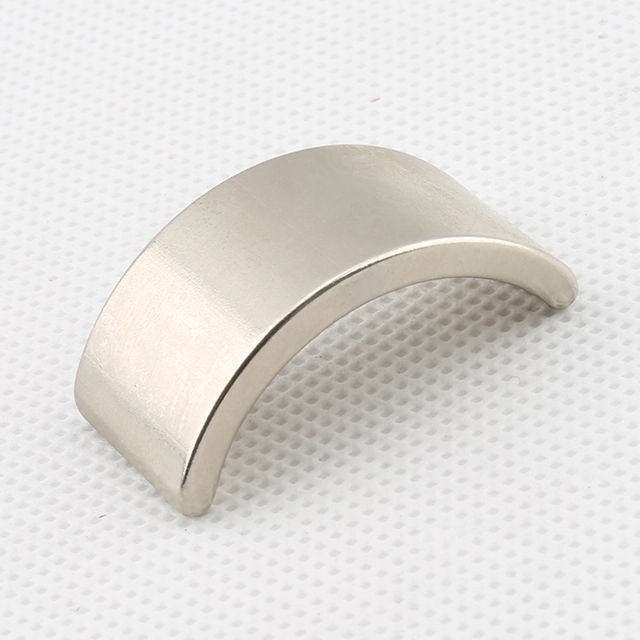
Magnets for electric motors are permanent magnets mounted inside the motor to create a fixed magnetic field. That field interacts with the electromagnetic field produced by current flowing through copper windings. The push and pull between the two fields is what spins the rotor.
Most modern motors use neodymium-iron-boron magnets because they deliver the strongest field per unit of volume. Ferrite magnets appear in lower-cost, larger motors. Samarium cobalt shows up in high-temperature or high-reliability applications. The type you choose shapes the motor’s size, efficiency, torque curve, and cost.
How Magnet Choice Changes Motor Performance
The magnets for Electric Motors are not a passive part. It directly sets the ceiling on what the motor can do.
A stronger Magnets for Electric Motors produces more torque for the same current. That means a smaller motor can do the same job, which matters enormously in electric vehicles and handheld tools where space and weight are tight.
Magnet strength also affects efficiency. A stronger field reduces the current needed to produce a given torque, which lowers resistive losses in the windings. This is one reason permanent magnet motors outperform induction motors in many applications.
Temperature rating is the constraint that catches people out. Standard neodymium grades lose strength above 80 degrees Celsius. High-temperature grades use suffixes like H, SH, and UH to indicate limits up to 120, 150, and 180 degrees Celsius. Motors running continuously under load get hot inside, and the internal temperature is often far higher than the ambient temperature around the housing.
Shapes Used Inside Motors
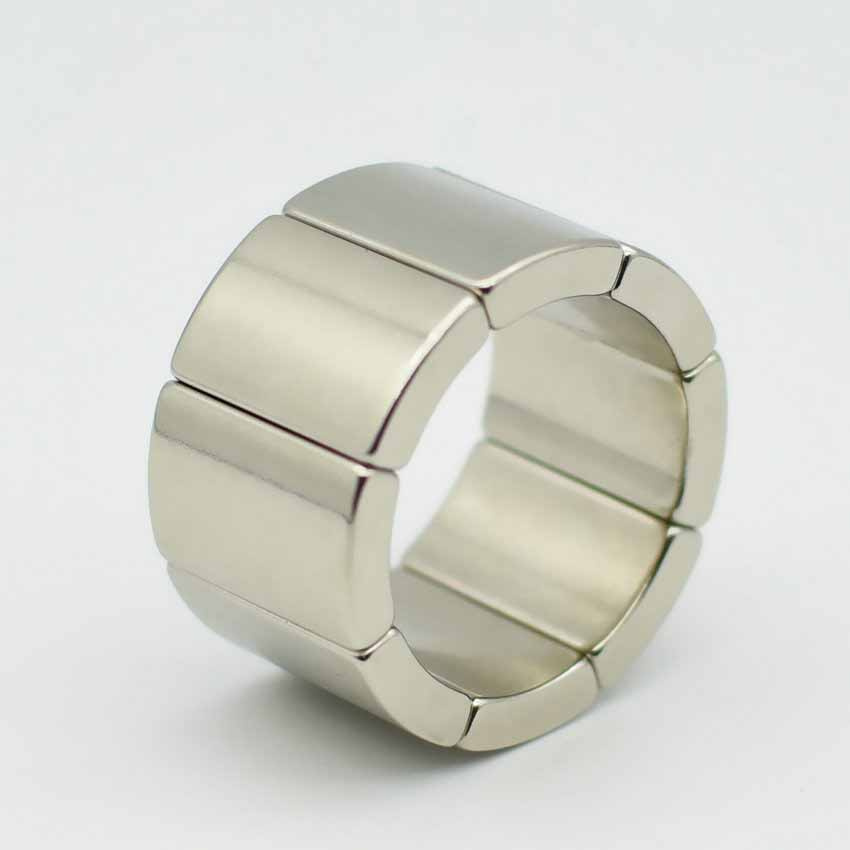
Magnets for electric motors come in several geometries, and the geometry has to match the motor architecture.
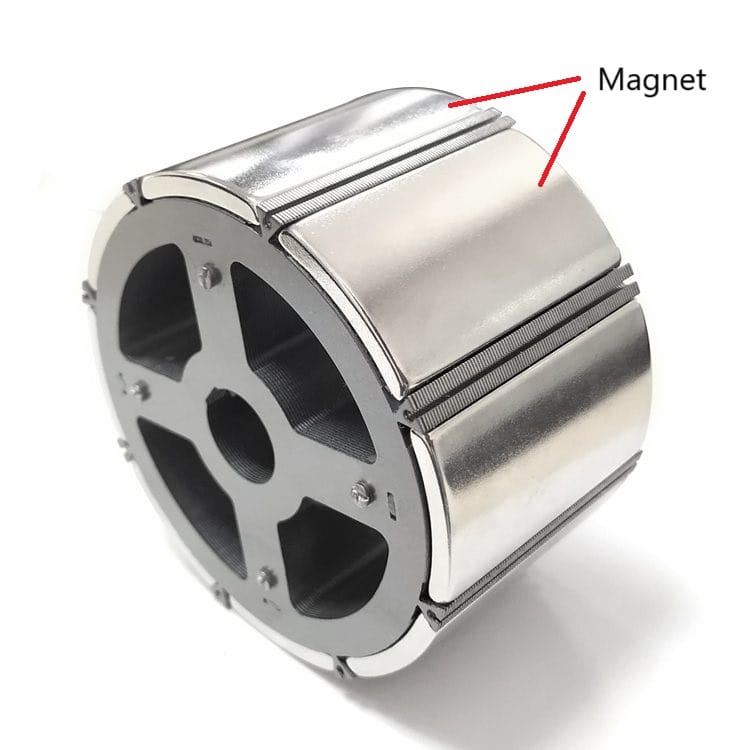
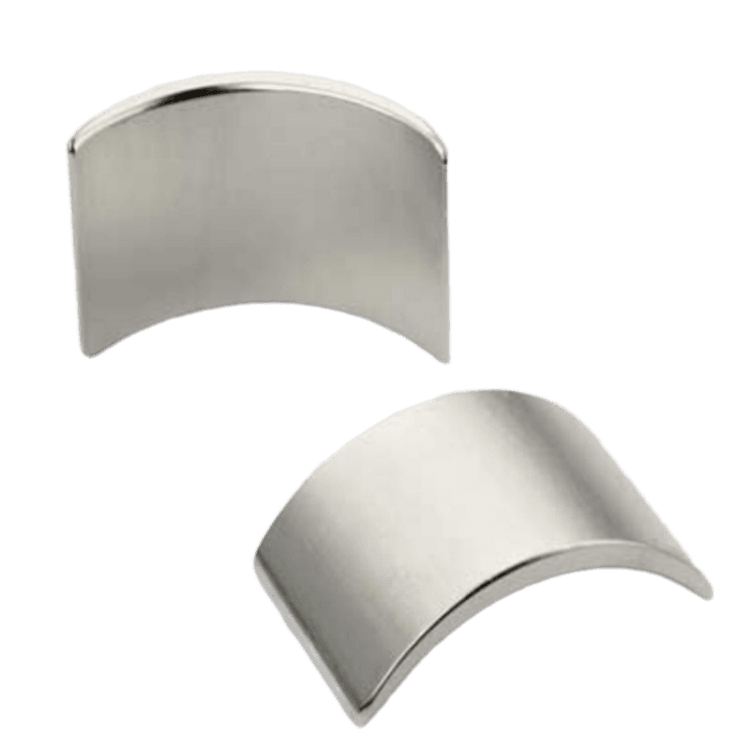
Arc segment magnets for Electric Motors are the most common. They are curved to match the rotor’s circumference and are magnetized radially, with the north pole facing outward. Multiple segments form a complete ring. The number of segments equals the number of magnetic poles.
Ring magnets combine all the segments into one piece with multiple poles magnetized around the circumference. Assembly is simpler because there are fewer parts to bond, but producing a large multi-pole ring requires more sophisticated tooling.
Bar and wedge magnets appear in linear motors and axial flux designs. In a linear motor, magnets are arranged in a row along the stator to create a traveling field. Axial flux motors place magnets on a flat disc rather than a cylinder.
Disc magnets serve small DC motors, vibration motors, and sensor applications where a compact field is enough.

What to Check Before Ordering
Specifying magnets for electric motors correctly requires more than picking a grade.
Confirm the magnetization direction in writing. Axial and radial magnetization are not interchangeable, and suppliers use different terminology. Ask for a diagram showing pole orientation.
Check the coercivity, not just the grade. Grade tells you the energy product. Coercivity tells you how well the magnet resists demagnetization under heat and opposing fields. A high-grade magnet with low coercivity can still fail in a hot motor.
Verify the dimensional tolerances. Magnets for Electric Motors must fit into rotor slots or bond cleanly to a rotor surface. Variations cause imbalance, vibration, and noise. Tight tolerances cost more, so specify them only where they matter.
Review the coating. Motors can expose magnets to moisture, oil, and coolant. Epoxy coatings outperform nickel plating in these conditions. Some electric vehicle motors use specialized coatings compatible with transmission fluid.
Ask about the maximum operating temperature the magnet for Electric Motors will actually see. Then add margin.

Common Mistakes That Ruin Motor Magnets
Most motor magnet failures trace back to a handful of avoidable errors.
Choosing grade without checking coercivity is the most frequent mistake. Buyers see “N52” and assume it is the best option. In a hot motor, an N42 with higher coercivity can outperform an N52 with lower coercivity.
Ignoring the internal temperature is the second. Engineers measure the outside of the motor housing and assume that is the operating temperature. The magnets for Electric Motors sit closer to the windings, where temperatures run much higher.
Specifying too-tight tolerances on non-critical dimensions is the third. This drives up cost without improving performance. Focus precision where it matters: the magnet face that meets the air gap, and the surfaces that bond to the rotor.
Skipping coating verification happens often in prototyping. The prototype works fine indoors, then the production units corrode in service because the coating was thinner or less uniform than expected.
Reusing a magnet specification from a different motor design is another common problem. Pole count, air gap, and rotor diameter all change the requirements. What worked in one motor may underperform badly in another.
How to Compare Magnet Suppliers
Price is the easiest thing to compare and the least useful on its own.
Ask for material test reports. Genuine N52 has remanence around 1.43 to 1.48 Tesla. If a quote comes in far below others for the same grade, suspect substitution.
Request demagnetization curves at your operating temperature. This shows how much field strength remains when the motor is hot. Suppliers who cannot provide this data are not equipped for motor work.
Confirm production capability. Arc segments and multi-pole rings require specialized pressing and magnetizing equipment. A supplier who only makes discs may not be able to hold the tolerances motor magnets need.
Check references in your industry. Automotive, medical, and industrial motor buyers all have different quality expectations. A supplier with relevant experience understands the specific requirements.
Finally, evaluate total cost rather than unit price. Shipping, import duties, tooling amortization, and quality risk all contribute. A slightly higher price from a reliable supplier is usually cheaper overall.
Magnetization Patterns and Pole Alignment
Multi-pole magnetization is common in magnets for electric motors, and the pole pattern must match the motor’s electrical design.
In a typical rotor, magnets for Electric Motors alternate north-south around the circumference. Each pole pair corresponds to one electrical cycle. Getting the pole count wrong changes the motor’s speed constant and torque constant, which means the controller will not drive it correctly.
Skewing is another consideration. Some motor designs skew the magnet poles slightly along the rotor’s length to reduce cogging torque. Cogging causes notchy rotation and vibration at low speeds. Skewed magnetization reduces it but requires specialized magnetizing fixtures.
Pole alignment between adjacent magnets must be consistent. If one segment is rotated slightly relative to its neighbors, the field becomes uneven and the motor vibrates. This is why dimensional tolerances on arc segments are so tight.
Hall sensor timing also depends on pole placement. If the magnets are misaligned, the controller receives incorrect position feedback and efficiency drops.
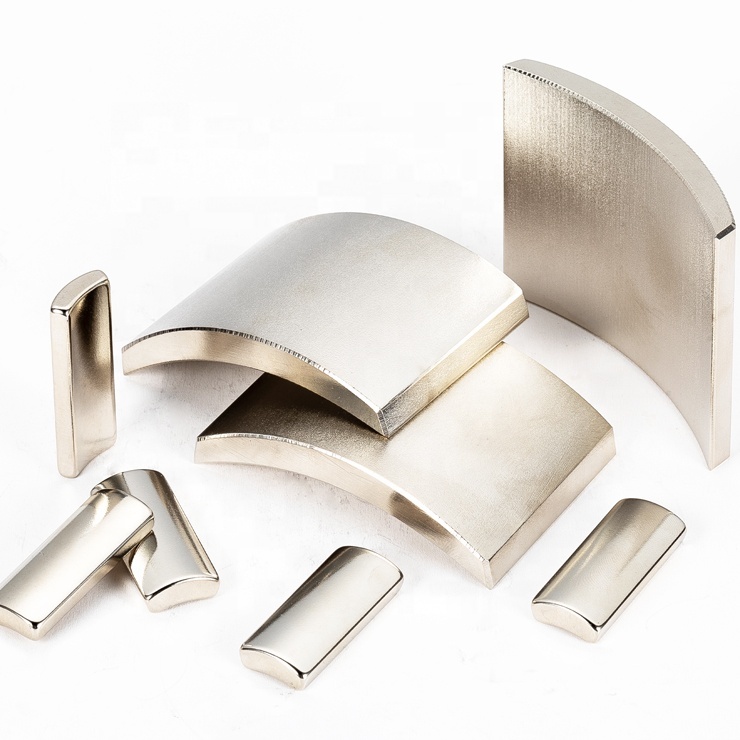
How Magnet Grade Selection Affects Electric Motor Efficiency
Choosing the right grade of magnets for electric motors is a balancing act between performance, cost, and thermal limits. Many engineers default to the highest available grade, assuming stronger is always better. That assumption often leads to unnecessary expense and, in some cases, worse performance.
Neodymium magnets for electric motors grades run from N35 to N52, with the number representing the maximum energy product. A higher grade produces more magnetic flux from the same volume. In a motor, that translates to more torque per amp of current, which improves efficiency and allows a smaller motor package. This is why high-performance applications lean toward N48 and N52.
But higher grades come with two penalties. First, cost. An N52 magnet can cost 30 to 50 percent more than an N35 of identical dimensions. Second, brittleness. Higher grades are more prone to chipping and cracking during handling and assembly. In a high-volume motor production line, that matters.
More importantly, grade alone does not determine how magnets for electric motors behave under heat. Coercivity does. Two magnets with the same grade can have very different coercivity values, and the one with higher coercivity resists demagnetization far better at elevated temperatures. An N42 with high coercivity may outperform an N52 with low coercivity in a motor that runs hot.
This is why smart motor designers specify both grade and temperature rating. A grade like N42SH tells you the strength and the thermal limit in one designation. For motors operating continuously under load, the SH or UH suffix is often more important than pushing the grade number higher.
The practical approach is to start with the thermal requirement, then select the lowest grade that meets the torque target at that temperature. This keeps cost down and reduces brittleness risk. Overspecifying grade is one of the most common and expensive mistakes in motor magnet sourcing.
FAQ: Your Magnets for Electric Motors Questions Answered
1. Why do magnets for electric motors lose strength over time?
The main cause is heat. Exceeding the magnet’s rated maximum temperature causes irreversible loss. Strong opposing magnetic fields, such as during an electrical fault, can also partially demagnetize the magnets. Physical damage and corrosion play a role too. A well-specified magnet in a properly cooled motor should hold its strength for the motor’s entire service life.
2. Can I replace the magnets in a failed motor?
Yes, but it is rarely economical for small consumer motors. For large industrial and electric vehicle motors, replacement can make sense. You must match the original grade, coercivity, dimensions, and magnetization pattern exactly. The rotor also needs rebalancing after reassembly. Any mismatch in pole alignment will cause vibration.
3. Are neodymium magnets always the best choice for motors?
No. Neodymium offers the highest strength, which helps with size and efficiency. But ferrite magnets cost far less and tolerate higher temperatures and moisture without coating. Samarium cobalt performs best in extreme heat and corrosive environments. The right choice depends on your motor’s size constraints, thermal conditions, and budget.
Conclusion
Magnets for electric motors do more than generate a field. They set the limits on torque, efficiency, and thermal durability. Getting the specification right means checking coercivity alongside grade, confirming magnetization direction and pole alignment, and matching the coating to the real operating environment. Compare suppliers on test data and relevant experience rather than price alone. Do that, and your motor will deliver the performance and lifespan your product needs.
How a Custom Magnet Manufacturer Supports Prototype to Production Transition Greatly