A magnet with a hole through the middle solves problems that solid magnets cannot. Strong ring magnets let you bolt, thread, or align a magnet in ways that flat discs never allow. This guide explains what they are, how to specify them, and where they work best.
What Are Strong Ring Magnets
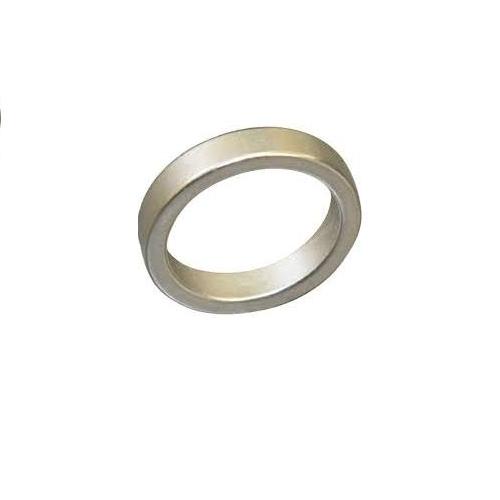
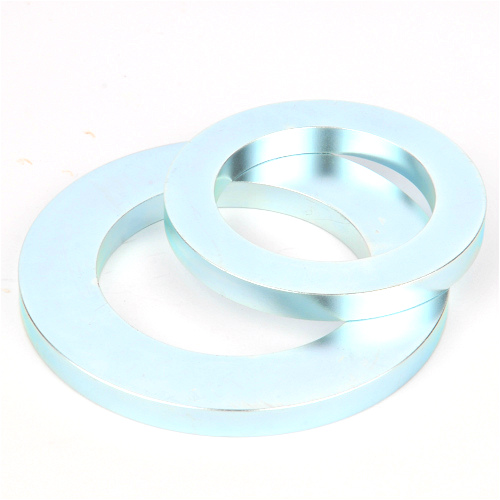
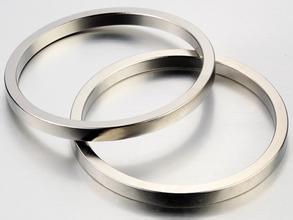
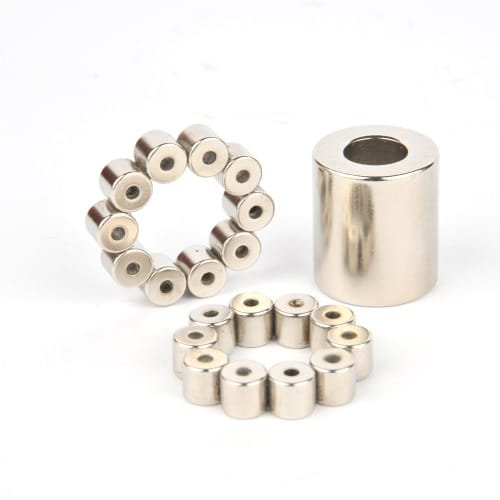
Strong ring magnets are donut-shaped permanent magnets with a central hole. The outer diameter, inner diameter, and thickness define the shape. Most are made from neodymium-iron-boron, the strongest permanent magnet material available. Ferrite and samarium cobalt versions exist for cost-sensitive and high-temperature applications.
The hole is the defining feature. It allows a screw, bolt, shaft, or threaded rod to pass through the magnet. That opens mounting options that are impossible with solid discs. You can fasten a ring magnet to a surface mechanically while the magnetic face stays fully exposed for holding. The ring geometry also distributes the magnetic field around the circumference rather than concentrating it on a flat face.
How the Shape Affects Magnetic Performance
Geometry changes magnetic behavior, and a ring behaves differently from a solid disc of the same outer diameter.
The hole removes magnetic material from the center, where a disc magnet contributes relatively little to the external field anyway. The result is that a strong ring magnet often delivers holding force close to a solid disc of the same outer diameter, but at lower weight and material cost. The field is slightly weaker because less magnetic volume is present, but the reduction is usually smaller than buyers expect.
Ring geometry also affects field distribution. The field lines loop from the outer edge, through the hole, and back. This creates a more complex field pattern than a flat disc, which matters in sensor and speaker applications where field shape is as important as field strength.
The outer diameter drives holding force. A larger ring contacts more surface area and produces more total flux. The inner diameter affects weight and mounting options more than it affects force, as long as the wall thickness remains reasonable. Very thin walls reduce strength and increase the risk of cracking.
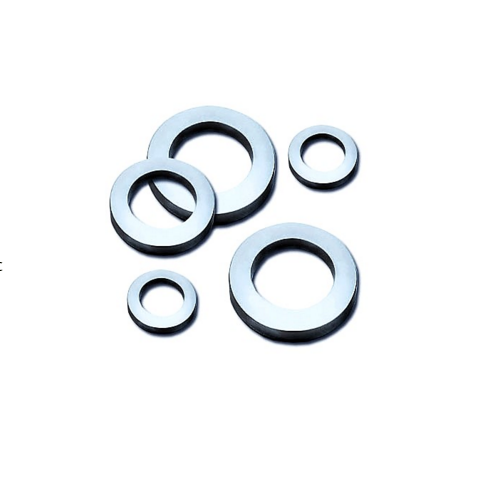
Magnetization Directions for Strong Ring Magnets
This is the specification that causes the most ordering errors. There are three common patterns.
Axial magnetization places the north and south poles on the two flat faces. Field lines run through the hole and around the outside. This is the standard configuration for holding, mounting, and most general applications. If you are unsure which type you need, axial is usually correct.
Diametric magnetization places the poles on opposite sides of the ring wall. The field runs sideways across the ring. This pattern is used in position sensors, magnetic encoders, and some motor designs. It is less common and more expensive to produce.
Multi-pole magnetization puts several alternating poles around the circumference. This appears in magnetic encoder rings and sensor targets where the ring rotates and a sensor reads pole transitions. The pole pitch must match the sensor’s requirements exactly.
Always confirm the direction in writing and ask for a diagram. Once the magnet is produced, the magnetization pattern cannot be changed.
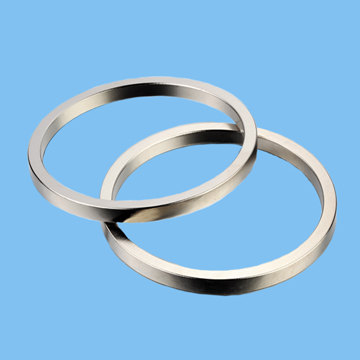
Grades and Temperature Ratings
Neodymium strong ring magnets come in grades from N35 to N52. Higher grades produce more force per unit of volume, which matters when the ring must be thin or small.
Temperature suffixes change the limits. Standard N grades work up to 80 degrees Celsius. M grade reaches 100. H reaches 120. SH reaches 150. UH reaches 180. EH reaches 200. Each step adds dysprosium or terbium and increases cost.
For rings used inside motors or enclosed assemblies, the temperature rating often matters more than the grade number. A hot environment will demagnetize a standard grade permanently, regardless of how strong it was at room temperature.
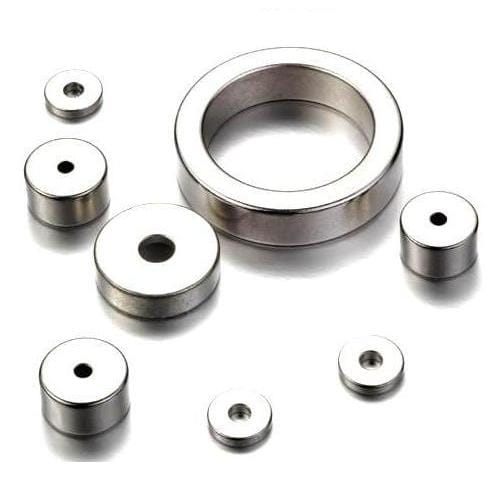
Where Strong Ring Magnets Are Used
The hole makes these strong ring magnets the right choice in several specific applications.
Fastening and mounting applications use the hole for a screw or bolt. The magnet holds a panel or cover in place while the screw provides mechanical security. This combination is far stronger than magnetism alone and resists sliding and vibration.
Loudspeakers use strong ring magnets in the driver assembly. The ring surrounds the voice coil, and the hole provides space for the coil former to move. The uniform field around the circumference keeps cone motion linear, which reduces distortion.
Sensors and encoders use strong ring magnets with diametric or multi-pole magnetization. As the ring rotates, the changing field is read by a hall effect or magnetoresistive sensor. The pole pattern determines the resolution and accuracy of the reading.
Magnetic couplings transmit torque through a sealed barrier without a physical shaft connection. Two strong ring magnets face each other across a non-magnetic wall. As one rotates, the other follows. This is common in pumps handling hazardous fluids.
Filtration and separation equipment uses ring magnets to capture ferrous particles from flowing material. The hole allows the magnet to be mounted on a rod or shaft, and the field extends outward to trap metal contaminants.
How Temperature Limits Affect Strong Ring Magnets
Temperature is the specification that most often determines whether a strong ring magnet survives in service. The grade number tells you how strong the magnet is at room temperature. It says nothing about how it behaves when it gets hot.
A standard neodymium ring magnet is rated for continuous operation up to 80 degrees Celsius. Below that point, strength drops slightly as temperature rises, but the loss reverses completely on cooling. Above that point, some magnetic domains flip and do not recover. This irreversible loss is permanent, and pushing far enough past the limit causes severe demagnetization.
The temperature suffix is the solution. M grade raises the limit to 100 degrees Celsius. H reaches 120. SH reaches 150. UH reaches 180. EH reaches 200. Each step adds dysprosium or terbium to raise intrinsic coercivity, and each step increases cost. For strong ring magnets used inside motors, speakers, or sealed enclosures, the suffix often matters more than the grade number itself.
The trap is measuring the wrong temperature. Engineers check the outside of a housing and assume the magnet sees the same conditions. In reality, internal temperatures run 30 to 50 degrees higher in operating equipment. Build in at least 20 degrees of margin above your measured worst case.
When ordering strong ring magnets for any warm environment, specify the suffix explicitly. Writing “N42” alone leaves the temperature rating undefined, and a supplier may ship a standard grade that fails in service. Also request the demagnetization curve at your operating temperature. A supplier who cannot provide that data cannot guarantee performance where it matters.
How to Specify the Strong Ring Magnets
Specifying correctly means covering several details, not just dimensions.
Confirm the outer diameter, inner diameter, and thickness with tolerances. Clarify whether dimensions are before or after coating, since coating adds thickness.
State the grade and temperature suffix together. “N42SH” tells a supplier far more than “N42” alone.
Request the magnetization direction with a diagram. Axial, diametric, and multi-pole rings are not interchangeable.
Specify the coating type and thickness. Nickel plating suits indoor use. Epoxy handles moisture and outdoor exposure. Parylene serves medical applications.
Ask for the demagnetization curve at your operating temperature if the application runs warm.
Request samples before full production and test them in your actual assembly.
How to Verify Strong Ring Magnets
Grade substitution and dimensional errors are common in the magnet market. A supplier advertises one specification and ships another, and the buyer discovers the problem only after the finished product fails. Verification before production protects your project.
Start with a material test report. For the neodymium strong ring magnets, the report should show measured remanence, intrinsic coercivity, and maximum energy product. Genuine N42 has remanence around 1.29 to 1.32 Tesla. If the values fall outside the published range for the claimed grade, ask for an explanation before proceeding.
Measure the dimensions yourself. Check the outer diameter, inner diameter, and thickness with calipers. Confirm whether the quoted size is before or after coating, since coating adds thickness. A ring specified at 20 millimeters outer diameter may measure 20.2 millimeters after plating, which can matter in a tight bore.
Test the magnetic field. A gaussmeter placed at a fixed distance from the ring surface gives a repeatable reading that you can compare across batches. If the field strength drops between shipments, the grade or the magnetization may have changed.
Confirm the magnetization direction by checking pole locations with a small compass or pole indicator. Axial and diametric rings look identical but behave completely differently. This check takes seconds and prevents a costly mistake.
Inspect the coating for uniformity, chips, and blisters. Run a salt spray test on a sample if the application involves moisture. Poor coating adhesion shows up quickly under accelerated testing.
For critical applications, send a sample to an independent laboratory for hysteresisgraph testing. The cost is small compared with the cost of field failures. Strong ring magnets are reliable components, but only when you receive exactly what you specified.
Common Mistakes When Buying Strong Ring Magnets
A few recurring errors cause most problems.
Choosing the wrong magnetization direction is the most common and the most costly. Diametric rings are sometimes ordered when axial was intended, and the parts cannot be salvaged.
Ignoring the wall thickness is the second. A ring with a very thin wall may crack during assembly or under load. Minimum wall thickness should be discussed with the supplier for your specific size.
Skipping coating verification happens often in prototyping. The prototype works indoors, then production units corrode in service because the coating was thinner than specified.
Ordering without accounting for coating thickness causes fit problems. A ring specified at 10 millimeters outer diameter may measure 10.2 millimeters after plating.
Assuming all ring magnets hold the same way is another error. The hole changes the field pattern, and holding force is not always identical to a solid disc of the same outer size.
FAQ: Your Strong Ring Magnets Questions Answered
1. Is a ring magnet weaker than a solid disc of the same size?
Slightly, because the hole removes magnetic material. However, the missing material is at the center, where a disc contributes little to the external holding field. In practice, a strong ring magnet often delivers holding force close to a solid disc of the same outer diameter, with lower weight.
2. What is the difference between axial and diametric magnetization?
Axial magnetization places the poles on the flat faces of the ring. Diametric magnetization places the poles on opposite sides of the ring wall. Axial is standard for holding and mounting. Diametric is used in sensors, encoders, and rotating applications where the field must sweep past a fixed sensing point.
3. Can strong ring magnets be used in motors?
Yes. Ring magnets appear in brushless motors, stepper motors, and magnetic couplings. Multi-pole rings are common because a single piece replaces several arc segments, simplifying assembly. Temperature rating and coercivity are critical in motor applications because the operating environment is warm.
Conclusion
Strong ring magnets solve problems that solid magnets cannot, thanks to a hole that enables mechanical fastening, shaft mounting, and uniform field distribution around a circumference. Getting the right one means specifying magnetization direction, grade, temperature rating, dimensions, coating, and tolerances together. Verify with samples and test data before committing to production. Done properly, a ring magnet becomes one of the most versatile components in your design.
How to Understand Permanent Magnet Price Before You Place an Order