Rectangular magnets solve problems that round ones cannot. Neodymium block magnets offer flat faces, straight edges, and a field pattern that resists sliding better than any other shape. This guide explains what they are, how to specify them, and where they outperform discs.
What Are Neodymium Block Magnets
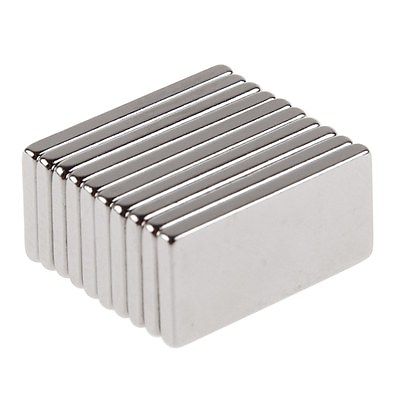
Neodymium block magnets are rectangular or square permanent magnets made from neodymium-iron-boron, the strongest magnetic material available commercially. They have six flat faces, with the magnetic poles typically located on the two largest opposing faces.
The rectangular shape matters. A block has straight edges that locate precisely against fixtures, frames, and machined surfaces. That makes them easier to align than round magnets, which can rotate out of position. They also resist shear forces well, meaning they hold their place when a load pulls sideways rather than straight away from the surface.
Most neodymium block magnets come with a nickel-copper-nickel coating for corrosion protection. Epoxy, parylene, and gold options exist for demanding environments. Sizes range from tiny 3-millimeter cubes used in crafts to large industrial blocks weighing several kilograms.
Why the Rectangular Shape Performs Differently
Geometry changes magnetic behavior, and blocks behave differently from discs in ways that matter in real designs.
The flat faces of a block concentrate the magnetic field across a wide, uniform area. That produces consistent holding force across the entire contact surface rather than a gradient. When you press a block against a steel plate, the full face engages, which maximizes the effective contact area.
The straight edges also create resistance to rotation. A disc magnet can spin freely under a shear load, but a block pressed against a surface cannot rotate without lifting. This makes blocks the better choice for applications where the load pulls sideways, such as tool holders on vertical surfaces or magnetic jigs on machine tables.
The field pattern around a block is more directional than around a disc. Field lines emerge from the pole face and spread outward, but the rectangular geometry creates a more uniform flux distribution along the length. This is why blocks appear in reed switch assemblies and sensor applications where a predictable field is needed.
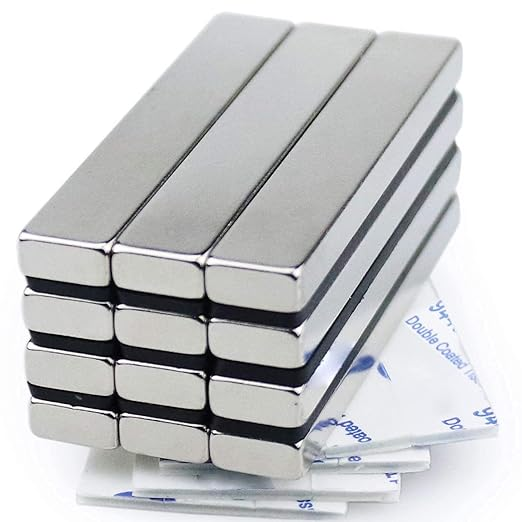
Magnetization Directions for neodymium Block magnets
Choosing the wrong magnetization direction is the most common ordering error with neodymium block magnets. There are three standard options.
Through-thickness magnetization places the poles on the two largest faces. For a block measuring 50 by 10 by 5 millimeters, this means the 50 by 10 faces carry the poles. This is the standard configuration for holding and mounting because it provides maximum contact area.
Through-length magnetization places the poles on the two smallest end faces. The field extends along the length of the block, which suits sensor work, reed switches, and end-on approach applications. Holding force against a flat plate is much lower in this orientation.
Through-width magnetization places the poles on the two long narrow edges. This is less common but appears in specialty applications where the field must emerge from the side.
Multi-pole blocks carry alternating poles along one face. These are used in magnetic encoders and linear sensor targets. The pole pitch must match the sensor’s specification exactly.
Always request a diagram showing pole orientation before ordering. Once produced, the magnetization direction cannot be changed.
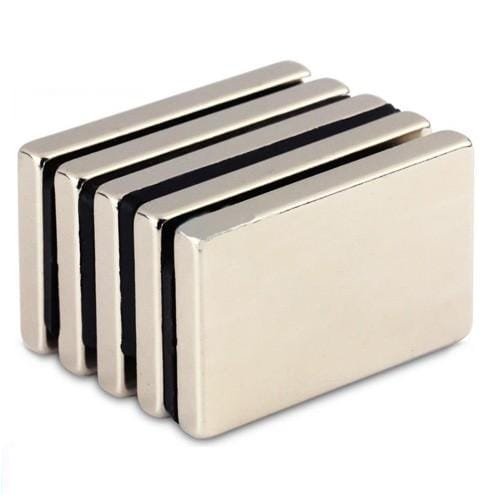
Grades and Temperature Ratings
Neodymium block magnets come in grades from N35 to N52. Higher grades deliver more magnetic energy per unit of volume, which allows smaller blocks to do the same job.
Temperature ratings use letter suffixes. Standard N grades operate up to 80 degrees Celsius. M reaches 100. H reaches 120. SH reaches 150. UH reaches 180. EH reaches 200. Each step adds dysprosium or terbium and increases cost.
For blocks used in motors, generators, or any sealed assembly that runs warm, the suffix matters more than the grade number. A high-grade magnet with a low temperature rating will demagnetize permanently in a hot environment.
Where Neodymium Block Magnets Excel
The rectangular shape gives blocks an edge in several specific applications.
Magnetic jigs and fixtures use blocks because the straight edges locate against fences and stops. Woodworkers and machinists use them to hold workpieces in position during cutting, drilling, or assembly. The block resists sliding, which round magnets handle poorly.
Tool holders on vertical surfaces benefit from the shear resistance of blocks. A block pressed against a steel cabinet or pegboard holds a wrench or pliers without rotating or slipping.
Door catches and cabinet latches use blocks paired with steel strike plates. The flat faces provide reliable contact and consistent holding force over thousands of open-and-close cycles.
Sensor and switch applications use blocks magnetized through length. The elongated field allows the magnet to trigger a reed switch or hall sensor across a predictable distance.
Magnetic separators use banks of blocks arranged in rows. The rectangular geometry allows tight packing without gaps, which maximizes the magnetic field across the working area.
Consumer products use small blocks in packaging, display systems, and removable components where a flat magnetic interface is required.

How Shear Force Affects Neodymium Block Magnets in Real Applications
Most magnet specifications describe pull force, the force required to pull a magnet straight away from a steel surface. In real applications, that is rarely the force at work. Neodymium block magnets usually face shear force instead, where the load pulls sideways, parallel to the mounting surface.
Shear force behaves differently from pull force. When a load pulls straight away, the entire magnetic field resists at once. When a load pulls sideways, only a portion of the field resists the sliding motion, and the magnet can creep over time under a load well below its rated pull force. This is why a block rated for 20 kilograms of pull may slide under 5 kilograms of sideways load.
This is where the rectangular shape of a block becomes valuable. A disc magnet under shear load can rotate freely, which often leads to it rolling off the surface. A block pressed against steel cannot rotate without lifting one edge, and lifting an edge requires overcoming the full pull force. That geometry gives blocks significantly better shear resistance than discs of comparable strength.
Several factors reduce shear performance. Painted or coated surfaces provide a lower friction coefficient, allowing the block to slide more easily. Vibration accelerates creep, which is why blocks mounted on machinery need extra margin. Temperature changes can cause differential expansion between the magnet and the mounting surface, loosening contact over time.
The practical approach is to design for shear first. Mount blocks so gravity pulls the load downward along the surface rather than outward. Add a mechanical stop or ledge beneath the block when the load is heavy. Use a safety factor of at least five for shear-loaded applications, and test the actual assembly under real conditions rather than trusting the catalog pull rating. Neodymium block magnets are excellent in shear, but only when the design accounts for how that force actually behaves.
How to Specify Neodymium Block Magnets
Specifying correctly means covering several details together, not just dimensions.
State length, width, and thickness with tolerances. Clarify whether dimensions are before or after coating, since plating adds thickness.
Specify grade and temperature suffix together. “N42SH” tells a supplier far more than “N42” alone.
Confirm magnetization direction with a diagram. Through-thickness, through-length, and through-width blocks are not interchangeable.
Choose the coating based on environment. Nickel for indoor use. Epoxy for moisture and outdoor exposure. Parylene or gold for medical and electronic work.
Request samples before production. Test pull force and shear resistance on your actual surface with your actual load.

Common Mistakes When Buying Block Magnets
A few recurring errors cause most problems.
Choosing the wrong magnetization direction is the first and most costly. Blocks magnetized through length behave completely differently from those magnetized through thickness, and the error cannot be fixed after production.
Ignoring shear versus pull force is the second. Catalog ratings usually describe pull force straight away from the surface. Real applications often apply shear force, which behaves differently. Blocks resist shear well, but the rated number may not describe that performance.
Skipping coating verification is the third. A thin or damaged coating leads to corrosion, and corrosion permanently reduces strength.
Ordering without accounting for coating thickness causes fit problems. A block specified at 10 millimeters may measure 10.2 millimeters after plating.
Assuming all blocks are dimensionally accurate is the fourth. Sintered neodymium shrinks during processing, and tolerances vary between suppliers. If your assembly requires precision, specify ground dimensions.
FAQ: Your Neodymium Block Magnets Questions Answered
1. Are neodymium block magnets stronger than disc magnets?
Total holding force depends on volume and contact area, not shape alone. A block and a disc of the same volume produce similar peak force. The block resists sliding better because its straight edges prevent rotation, which makes it feel stronger in shear-loaded applications.
2. Can neodymium block magnets be used outdoors?
Yes, with the right coating. Epoxy-coated blocks handle moisture, salt spray, and temperature swings. Also confirm the temperature rating, since dark blocks in direct sun can get hot enough to affect standard grades.
3. What is the most common magnetization direction for neodymium block magnets?
Through-thickness is the most common, with poles on the two largest faces. This configuration provides maximum contact area for holding and mounting, and it is the default choice for most applications.
Conclusion
Neodymium block magnets bring flat faces, straight edges, and shear resistance that round magnets cannot match. The rectangular geometry makes them the right choice for jigs, fixtures, tool holders, and sensor applications where alignment matters. Getting the right block means specifying dimensions, grade, temperature rating, magnetization direction, and coating together. Confirm with samples and test data before production. Done properly, a block magnet becomes one of the most dependable components in your design.