Neodymium magnets are the strongest permanent magnets you can buy, but strength is only part of the story. Understanding neodymium magnet properties helps you avoid failures that have nothing to do with magnetic power. This guide covers the key characteristics, how they interact, and what to check before ordering.
What Are Neodymium Magnets
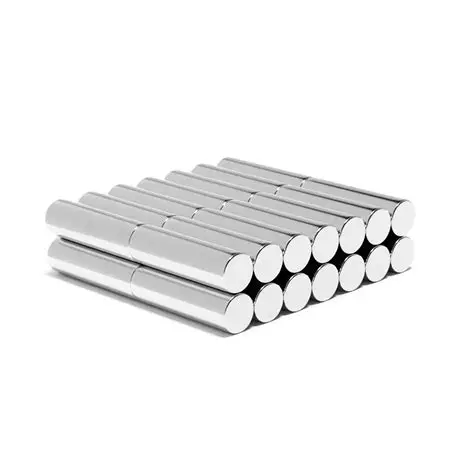
Neodymium magnets are permanent magnets made from an alloy of neodymium, iron, and boron. They are also called NdFeB magnets, after the chemical symbols of their main elements. Introduced commercially in the 1980s, they quickly replaced older materials in applications where size and weight mattered.
The reason is simple. Neodymium magnets store far more magnetic energy per unit of volume than ferrite or alnico. A neodymium disc the size of a coin can lift dozens of times its own weight. That advantage reshaped motor design, sensor technology, and consumer electronics. A modern smartphone speaker, for example, would be impossible at its current size using older magnet materials.
Those benefits come with trade-offs. Neodymium is brittle, corrodes easily, and loses strength when heated. Understanding neodymium magnet properties means understanding both the strengths and the limitations.
Magnetic Strength and Grade
The grade indicates how much magnetic energy the material can store. Neodymium grades run from N35 to N52. The number represents the maximum energy product in Mega-Gauss-Oersteds.
N35 sits at the entry level. N42 covers many general applications. N48 and N50 serve demanding industrial work. N52 represents the top of the commercially available range.
Higher grades deliver more flux from the same volume, which lets engineers shrink the magnet or increase performance. But higher grades are also more brittle and more sensitive to heat. They cost more, too. The gap between N35 and N52 pricing can reach 50 percent or more for identical dimensions.
In real designs, a larger lower-grade magnet often matches a smaller high-grade magnet at lower cost. Grade should be chosen to fit the application, not to chase the biggest number on the datasheet.
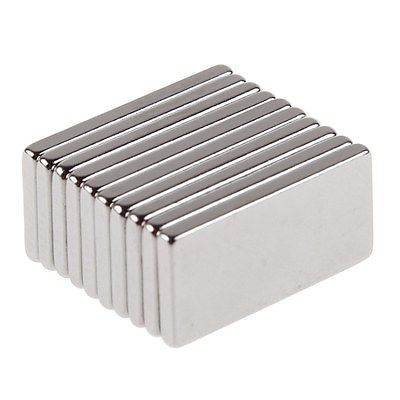
Remanence, Coercivity, and Energy Product
These three neodymium magnet properties describe magnetic behavior, and they are not interchangeable.
Remanence measures the magnetic flux density remaining after the magnetizing field is removed. It describes how strong the magnet is at room temperature with nothing working against it. Units are Tesla or Gauss.
Coercivity measures resistance to demagnetization. It describes how well the magnet holds its strength when exposed to heat or opposing magnetic fields. Units are Oersteds or kiloOersteds. This is the property that determines whether a magnet survives inside a hot motor.
Maximum energy product combines remanence and coercivity into a single figure. It represents the maximum magnetic energy the material can supply. That figure is the grade number.
Two magnets with the same grade can have different coercivity values depending on their temperature rating. An N42 and an N42SH share a nominal energy product but behave very differently at 150 degrees Celsius.
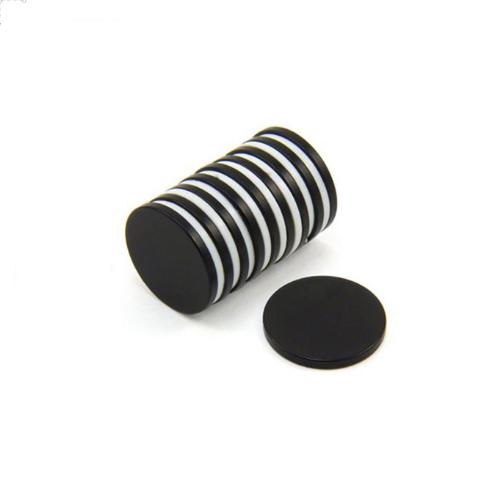
Temperature Behavior
Temperature affects neodymium magnets in two ways.
Reversible loss happens as the magnet heats up. Strength drops slightly, then recovers completely when the magnet cools. The reversible temperature coefficient for neodymium is roughly minus 0.11 percent per degree Celsius. At 100 degrees Celsius, the magnet is about 9 percent weaker than at room temperature. This loss is temporary.
Irreversible loss happens when the magnet exceeds its maximum operating temperature. Some magnetic domains flip and do not flip back on cooling. The magnet is permanently weaker. Push far enough past the limit, and the loss becomes severe.
Standard N grades are rated to 80 degrees Celsius. The suffixes M, H, SH, UH, and EH raise that limit to 100, 120, 150, 180, and 200 degrees Celsius respectively. Each step adds dysprosium or terbium, which raises cost.
This is why the temperature suffix often matters more than the grade number. A motor designer who specifies N52 without checking coercivity may end up with a magnet that demagnetizes in service.
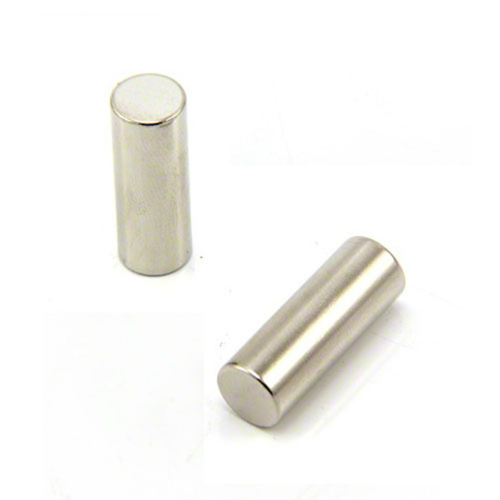
Mechanical Neodymium Magnet Properties
Neodymium magnets are hard and brittle. They behave more like ceramic than metal. They resist deformation but crack under impact or bending stress.
This brittleness affects handling, assembly, and design. Magnets allowed to snap together can chip at the edges. Press fitting into a tight bore can crack the material. Thermal cycling can initiate cracks if the coating and the magnet expand at different rates.
Sharp corners concentrate stress and are the most common starting point for cracks. Generous radii reduce that risk. Thin sections are more fragile than thick ones, which is why very thin discs need careful handling and packaging.
Machining is possible with diamond tooling and coolant, but it is slow and risky. Most neodymium magnets are formed close to final shape during pressing and sintering, with grinding limited to critical surfaces.
Corrosion Behavior
Bare neodymium corrodes quickly. The alloy reacts with moisture and oxygen, forming a powdery oxide that crumbles away. In humid air, surface oxidation begins within days. In direct contact with water or salt spray, a bare magnet can deteriorate within weeks.
This is why every neodymium magnet ships with a coating. Nickel-copper-nickel plating is standard and suits indoor use. Epoxy seals the surface against moisture, salt, and chemicals. Parylene provides a pinhole-free barrier for medical and high-reliability electronics. Gold plating serves conductive and biocompatible applications.
Coating integrity matters as much as coating type. A chip or scratch creates an entry point, and corrosion spreads underneath the plating. Handling procedures, packaging, and inspection all protect the investment.
Magnetic Orientation and Anisotropy
Neodymium magnets are anisotropic. The neodymium magnet properties are strongest along one specific axis, determined during pressing when the powder particles are aligned in a magnetic field.
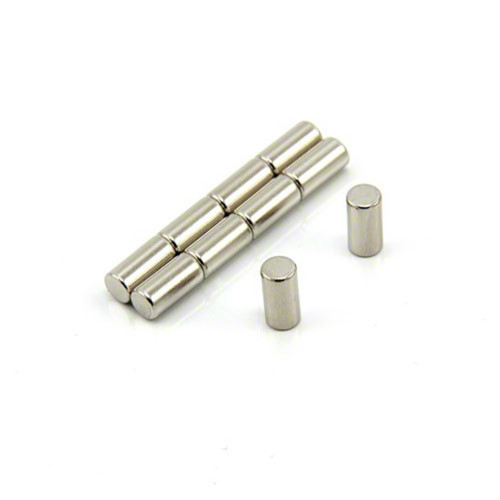
This means the magnetization direction must be specified. A disc magnetized axially has poles on the flat faces. The same disc magnetized diametrically has poles on opposite curved edges. The two are not interchangeable.
Multi-pole magnetization places several alternating poles on a single surface. This is common in encoder rings and magnetic sensor targets. The pole pitch must match the sensor’s requirements.
Getting the direction wrong makes the magnet useless for its intended purpose, and the error cannot be corrected after production.
How Neodymium Magnet Properties Change During Manufacturing
The neodymium magnet properties are not simply inherited from the raw alloy. They are created step by step during production, and small process variations produce measurable differences in the final part.
The alloy itself sets the ceiling. Neodymium, iron, and boron are melted together in precise proportions. Adding dysprosium or terbium raises coercivity. Adding cobalt improves temperature stability. Adding copper and gallium refines the grain structure. These choices determine which grade family the magnet can ultimately achieve.
Milling reduces the alloy to fine powder. Particle size affects how well the powder packs during pressing and how completely it sinters. Powder that is too coarse leaves residual porosity. Powder that is too fine oxidizes quickly and becomes difficult to handle. Both problems degrade the final neodymium magnet properties.
Pressing is where anisotropy is created. For high-grade magnets, an external magnetic field aligns the powder particles so their crystal axes point the same direction. Without this alignment, the finished magnet behaves isotropically and loses a large share of its potential strength. Alignment quality depends on field strength, powder flow, and die design.
Sintering controls density and microstructure. Temperature, time, and atmosphere all matter. Incomplete sintering leaves porosity that reduces remanence. Excessive grain growth lowers coercivity. The furnace cycle is where the balance between strength and heat resistance is struck.
Grinding and coating affect the finished dimensions and corrosion resistance. Coating thickness adds to the nominal size. Poor surface preparation causes adhesion failures.
Magnetization is the final step. Field strength must be sufficient to fully saturate the material. Weak magnetization leaves the magnet below its rated performance, even though every other property is correct.
How Temperature Cycling Degrades Neodymium Magnet Properties Over Time
A magnet that performs perfectly in a lab test can still fail in the field after months of thermal cycling. Understanding how repeated heating and cooling affects neodymium magnet properties helps engineers design for long-term reliability.
Neodymium magnets experience two types of strength loss under heat. Reversible loss occurs immediately as temperature rises and reverses completely on cooling. Irreversible loss occurs when the magnet exceeds its rated maximum and some magnetic domains do not recover. Most engineers account for the first and underestimate the second.
Thermal cycling adds a third factor. Each heating and cooling cycle stresses the material and its coating differently. The magnet expands and contracts at one rate. Nickel plating, epoxy, or parylene expands at another. Over hundreds of cycles, that mismatch creates microcracks at edges and corners. Once a crack forms, corrosion can start underneath the coating, and the magnet begins to lose material.
Cycling also accelerates gradual demagnetization at the edges of the magnet. These regions experience the strongest demagnetizing fields and are the first to lose alignment. In motors and generators that cycle continuously, edge demagnetization can reduce effective output over years of service.
The practical implication is that temperature ratings should not be treated as a pass or fail line. A magnet rated for 120 degrees Celsius used continuously at 115 degrees will age faster than the same magnet used at 60 degrees. Margin matters.
For critical applications, request thermal cycling test data from your supplier. A magnet that retains 98 percent of its field after 500 cycles between room temperature and its rated maximum is a safer choice than one with no cycling data at all. Neodymium magnet properties are not static. They evolve with service conditions.
How Corrosion Resistance Relates to Neodymium Magnet Properties
Corrosion resistance is not usually listed among the primary neodymium magnet properties, yet it determines how long a magnet survives in service. A magnet with excellent magnetic strength but poor corrosion protection will fail long before its magnetic potential is exhausted.
The base alloy is chemically reactive. Neodymium oxidizes readily in air and reacts aggressively with moisture. Unlike iron, which forms a protective oxide layer, neodymium oxide is powdery and non-adherent. It crumbles away, exposing fresh material underneath. This process continues until the magnet is consumed.
Coating is the primary defense, and coating quality depends on surface preparation. Magnets must be cleaned thoroughly before plating. Residual oils, dust, or oxidation prevent proper adhesion and cause blisters that flake off in service.
Porosity in the sintered material also affects corrosion behavior. Magnets with lower density have more internal surface area exposed to moisture once a coating breach occurs. High-density magnets resist corrosion better because there is less interconnected porosity for moisture to travel through.
Material composition plays a role as well. Cobalt additions improve corrosion resistance slightly. Dysprosium and terbium have minimal effect. The dominant factor remains the coating.
For buyers, the practical takeaway is straightforward. Specify the coating based on the environment, not on cost alone. Verify coating adhesion and thickness. And handle magnets carefully, because a chipped coating is the beginning of the end for neodymium magnet properties.
FAQ: Your Neodymium Magnet Properties Questions Answered
1. What is the maximum operating temperature for neodymium magnets?
It depends on the grade. Standard N grades are rated to 80 degrees Celsius. M grade reaches 100, H reaches 120, SH reaches 150, UH reaches 180, and EH reaches 200 degrees Celsius. Each step adds heavy rare earth content and cost. Always specify the temperature rating alongside the grade.
2. Why do neodymium magnets need a coating?
Bare neodymium corrodes rapidly in moisture and oxygen. The coating seals the surface and prevents oxidation. Nickel plating works indoors, epoxy suits outdoor and marine use, and parylene serves medical applications. A damaged coating creates a corrosion site, so handle magnets carefully.
3. Can neodymium magnets lose strength permanently?
Yes, under three conditions: exposure above the maximum operating temperature, strong opposing magnetic fields, and physical damage or corrosion. Under normal conditions at room temperature, a neodymium magnet loses less than 1 percent of its strength per decade.
Conclusion
Neodymium magnet properties extend well beyond magnetic strength. Grade describes energy product, coercivity describes resistance to demagnetization, and temperature ratings describe where the magnet can safely operate. Brittleness, corrosion behavior, and magnetization direction all shape how a magnet performs in real conditions. Specify grade and temperature together, verify coating and orientation, and test samples before production. Do that, and you get the full benefit of the strongest permanent magnet material available.
How to Understand the Great Round Magnet with Hole Price Before You Buy