Neodymium disk magnets are the workhorse of the magnet world. They hold cabinets closed, keep tools on walls, drive speaker cones, and sit inside sensors by the million. This guide explains how they differ from other shapes, how to specify them, and what most buyers get wrong.
What Are Neodymium Disk Magnets
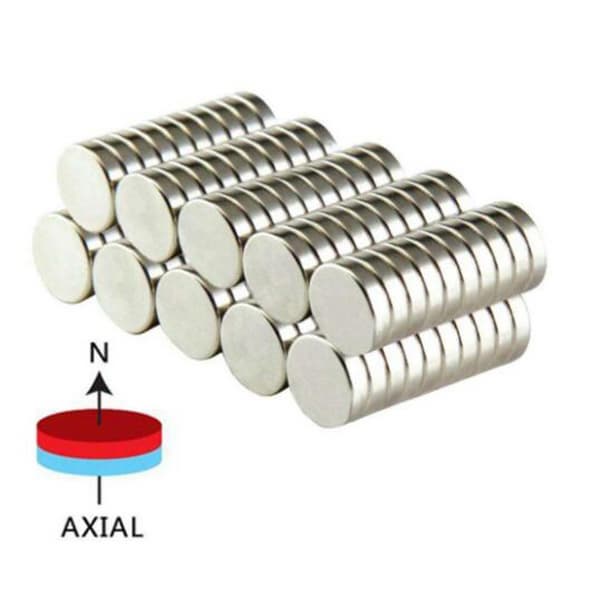
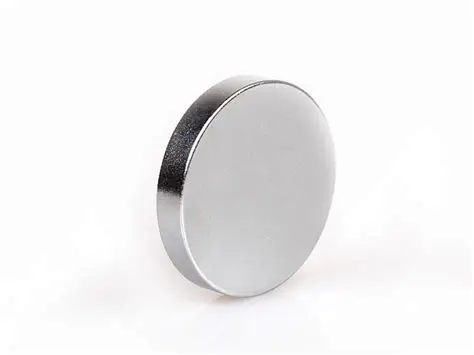
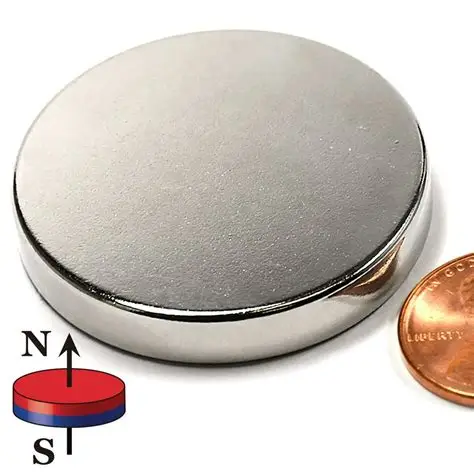
Neodymium disk magnets are flat, circular permanent magnets made from an alloy of neodymium, iron, and boron. The diameter is larger than the thickness, which gives them a coin-like appearance. They are the strongest permanent magnets available commercially, roughly ten times more powerful than ferrite magnets of the same size.
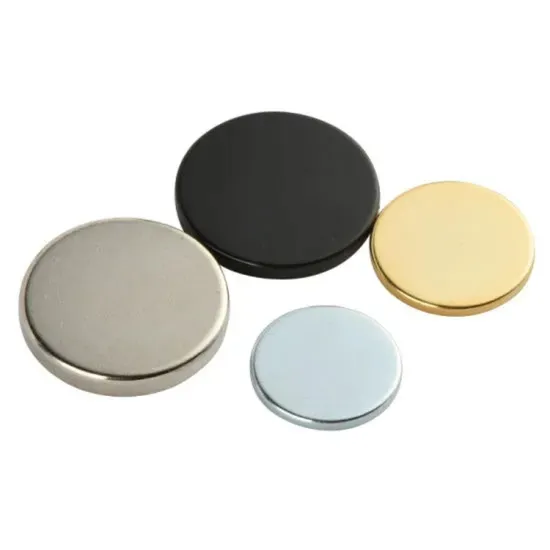
Most have a nickel-copper-nickel coating that gives them a bright silver finish and protects the reactive alloy underneath. Some are epoxy coated for outdoor use or gold plated for electronics. They range in size from 2-millimeter craft magnets to 100-millimeter industrial pieces.
The flat circular shape is what makes them so useful. Both large faces carry the magnetic poles, so the field concentrates on two flat surfaces. That produces strong holding force against a flat steel plate, which is exactly what most mounting and fastening jobs require.
How Disk Geometry Affects Performance
Diameter and thickness do different jobs, and understanding the difference helps you buy smarter.
Diameter controls holding force. A larger disk contacts more surface area, and magnetic force scales roughly with area. Doubling the diameter can multiply the pull force by four. If you need more holding power, going wider is usually more effective than going thicker.
Thickness increases field strength at the surface, but with diminishing returns. Past a certain point, extra thickness contributes little to the external field because the material deep inside the magnet sits too far from the target. A thin, wide disk frequently outperforms a thick, narrow one of the same volume.
Aspect ratio matters too. Very thin disks are fragile and chip easily at the edges. Very thick disks waste material. The most efficient shapes have a diameter roughly two to five times the thickness.
Magnetization Directions in Disk Magnets
Most neodymium disk magnets are axially magnetized, meaning the poles sit on the two flat faces. This is the standard configuration for holding and mounting.
Diametrically magnetized disks have poles on opposite curved edges of the rim. This pattern is used in sensors, encoders, and rotating assemblies where the field must sweep past a fixed sensing point. Diametric disks cost more and are less common.
Multi-pole disks carry several alternating poles on a single face. These appear in magnetic encoder targets and some sensor designs. The pole pitch must match the sensor’s requirement.
Confirm the direction in writing before ordering. Once produced, the magnetization pattern cannot be changed.
Grades and Temperature Ratings
Grades of Neodymium Disk Magnets run from N35 to N52. Higher grades produce more magnetic energy from the same volume, which matters when space is tight.
Temperature suffixes determine how much heat the magnet can take. Standard N grades work up to 80 degrees Celsius. M reaches 100. H reaches 120. SH reaches 150. UH reaches 180. EH reaches 200. Each step adds dysprosium or terbium, which raises cost.
For most household and craft applications, standard grades are fine. For motors, sensors, or any enclosed assembly that runs warm, the temperature suffix matters more than the grade number. A standard grade magnet in a hot enclosure will demagnetize permanently, no matter how strong it was at room temperature.
Common Applications for Neodymium Disk Magnets
This is the most versatile magnet shape, and it shows up nearly everywhere.
Home organization uses small disks for cabinet catches, refrigerator magnets, and tool holders. Adhesive-backed versions turn any lightweight object into a magnetic one.
Craft and DIY projects use disks for closures on boxes, bags, and albums. They are also popular for hidden mounting of photos and artwork on steel surfaces.
Speakers and audio equipment use disks in driver assemblies. The flat face provides a uniform field across the voice coil gap.
Sensors and switches use disks in hall effect sensors, reed switches, and magnetic encoders. The consistent field across the flat face makes them predictable in sensing applications.
Industrial fixtures use disks for workholding, magnetic chucks, and positioning. Larger disks provide substantial holding force for machining and assembly.
Consumer electronics use tiny disks in smartphone speakers, vibration motors, and magnetic connectors. Space constraints make high-grade neodymium the only viable option.
How to Specify and Buy neodymium disk magnets
Getting the right neodymium disk magnets means covering a few details that matter.
State the diameter and thickness with tolerances. Clarify whether dimensions are before or after coating, since nickel plating adds roughly 0.02 to 0.05 millimeters and epoxy adds more.
Specify the grade and temperature suffix together. “N42SH” is more useful to a supplier than “N42” alone.
Confirm the magnetization direction. Axial is standard for holding. Diametric serves sensors and rotating assemblies.
Choose the coating based on the environment. Nickel for indoor use, epoxy for moisture and outdoor exposure, parylene or gold for medical and electronic work.
Request samples before production. Test pull force on your actual surface with your actual load.
How Temperature Limits Affect Neodymium Disk Magnets
Temperature is the specification that catches most buyers off guard with neodymium disk magnets. The grade number tells you how strong the magnet is at room temperature. It says nothing about how the magnet behaves when it gets hot.
The standard neodymium disk magnets are rated for continuous operation up to 80 degrees Celsius. Below that point, strength drops slightly as temperature rises, but the loss reverses completely when the magnet cools. This reversible loss follows a coefficient of roughly minus 0.11 percent per degree Celsius, meaning a magnet at 70 degrees Celsius is about 8 percent weaker than at room temperature.
Above 80 degrees Celsius, the behavior changes. Some magnetic domains flip and do not flip back on cooling. This is irreversible loss, and it is permanent. Push far enough past the limit, and the magnet loses a substantial share of its strength with no way to recover it.
The solution is the temperature suffix. M grade raises the limit to 100 degrees Celsius. H reaches 120. SH reaches 150. UH reaches 180. EH reaches 200. Each step adds dysprosium or terbium to raise intrinsic coercivity, and each step increases cost. For neodymium disk magnets used inside motors, sensors, or sealed enclosures, the suffix often matters more than the grade number itself.
The trap is measuring the wrong temperature. Engineers check the outside of a housing and assume the magnet sees the same conditions. In reality, internal temperatures run 30 to 50 degrees higher in operating equipment. Build in at least 20 degrees of margin above your measured worst case.
When ordering neodymium disk magnets for any warm environment, specify the suffix explicitly. Writing “N42” alone leaves the temperature rating undefined, and a supplier may ship a standard grade that fails in service.
How to Test Neodymium Disk Magnets Before Use them
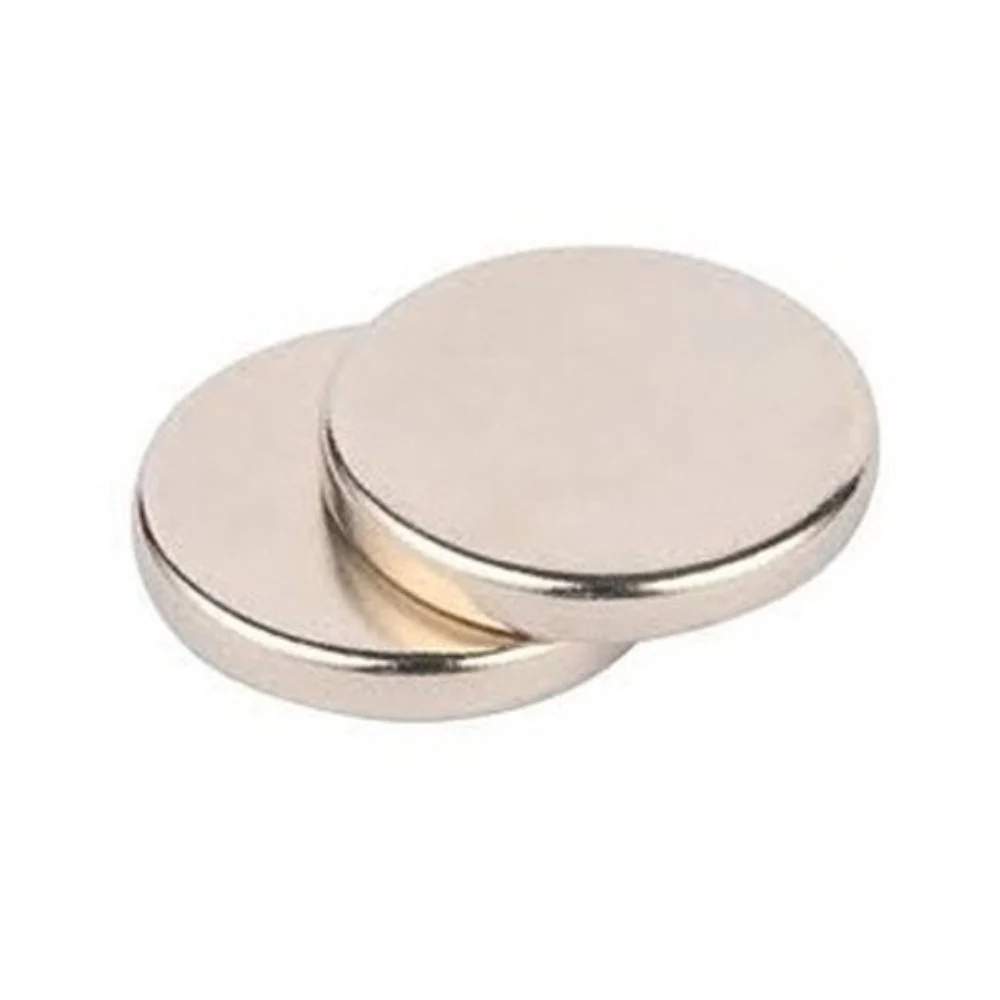
Buying neodymium disk magnets on specification alone is risky. Grade substitution, dimensional drift, and coating defects all happen in this market, and the problems usually surface only after your product reaches customers. A structured testing routine before production catches most of them.
Start with dimensional verification. Measure the diameter and thickness of a sample from each lot using calipers or a micrometer. Check several pieces, not just one, because variation within a batch matters as much as the nominal size. Confirm whether the quoted dimensions are before or after coating. Nickel plating adds roughly 0.02 to 0.05 millimeters, and epoxy can add 0.1 to 0.3 millimeters. If your assembly has a tight bore or recess, this difference decides whether the part fits.
Next, verify the grade. Request a material test report showing measured remanence, intrinsic coercivity, and maximum energy product. Genuine N42 has remanence around 1.29 to 1.32 Tesla. Genuine N52 sits near 1.43 to 1.48 Tesla. If the reported values fall below the published range for the claimed grade, ask for an explanation before proceeding. For critical applications, send a sample to an independent laboratory for hysteresisgraph testing. The cost is small compared with the cost of a field failure.
Test the magnetic field directly. A gaussmeter held at a fixed distance from the disk face gives a repeatable reading you can compare across batches. If field strength drops between shipments, something changed. This simple check catches grade substitution, incomplete magnetization, and process drift that dimensional inspection alone would miss.
Measure pull force on the surface you actually plan to use. Catalog ratings assume clean, thick, flat, unpainted steel. Paint, powder coating, adhesive, and thin sheet metal all reduce holding force, sometimes dramatically. A disk rated for 10 kilograms may hold only 3 kilograms on a painted cabinet door. Testing on the real surface, with the real load, tells you what the magnet will actually do.
Inspect the coating. Look for uniform color, smooth edges, and the absence of chips, blisters, or discoloration. Run a salt spray test on a sample if the application involves moisture. Poor coating adhesion shows up quickly under accelerated testing, and a coating breach is where corrosion begins.
Check the magnetization direction with a small compass or pole indicator. Axial and diametric disks look identical but behave completely differently. This check takes seconds and prevents an expensive mistake that cannot be corrected after production.
Finally, test at operating temperature if the application runs warm. Heat a sample to your worst-case internal temperature, hold it there for several hours, let it cool, and re-measure field strength. Any permanent drop indicates the grade is not suitable for your conditions.
Document every result. A simple spreadsheet tracking dimensions, field strength, pull force, and coating condition across lots builds a quality history. When something goes wrong months later, that record tells you whether the supplier drifted or the design changed. Testing neodymium disk magnets is not complicated, but doing it consistently is what separates a smooth production run from a costly recall.
Common Mistakes When Buying Neodymium Disk Magnets
A handful of recurring errors cause most disappointment.
Trusting the catalog pull force is the first. Ratings assume clean, thick, flat, unpainted steel. Paint, coating, and thin sheet metal reduce holding force significantly. Divide the rated figure by three for a realistic working load.
Ignoring the temperature rating is the second. Buyers chase a high grade number and overlook the suffix, then watch the magnet fail in a warm enclosure.
Skipping coating verification is the third. A thin or damaged coating leads to corrosion, and corrosion permanently reduces magnetic strength.
Assuming all disk magnets are interchangeable is the fourth. Magnetization direction, coating, and tolerance all vary, and two visually identical disks can behave very differently.
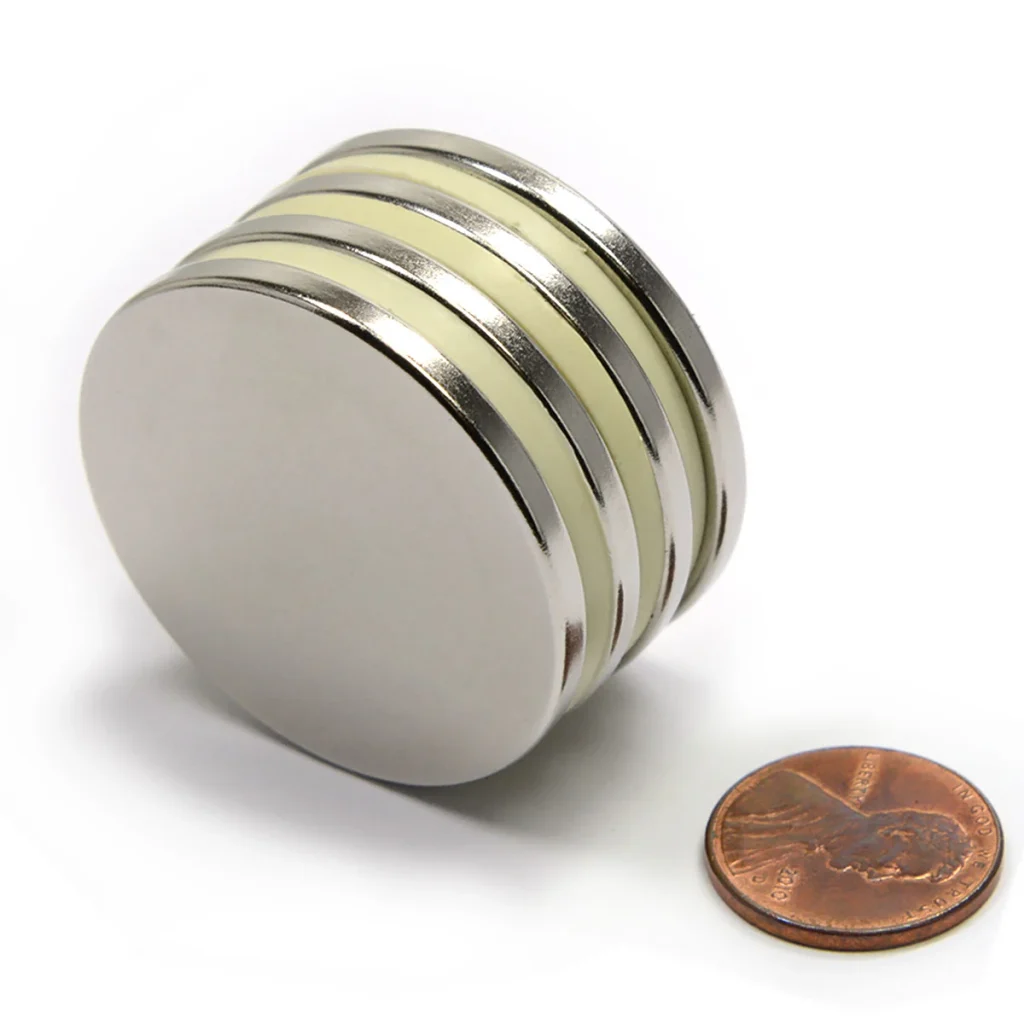
Forgetting about brittleness is the fifth. Neodymium disks chip easily at the edges. Allowing two magnets to snap together from a distance is the most common way to damage them.
FAQ: Your Neodymium Disk Magnets Questions Answered
1. What is the strongest neodymium disk magnet available?
Strength depends on both grade and size. N52 is the highest commercial grade, but a large N42 disk produces more total holding force than a small N52 disk. For maximum holding power, choose a larger diameter before chasing the highest grade.
2. Can neodymium disk magnets be used outdoors?
Yes, with the right coating. Bare neodymium corrodes quickly in moisture. Epoxy-coated disks handle outdoor exposure, salt spray, and temperature swings. Also confirm the temperature rating, since dark surfaces in direct sun can get hot enough to affect standard grades.
3. Why do my neodymium disk magnets keep chipping?
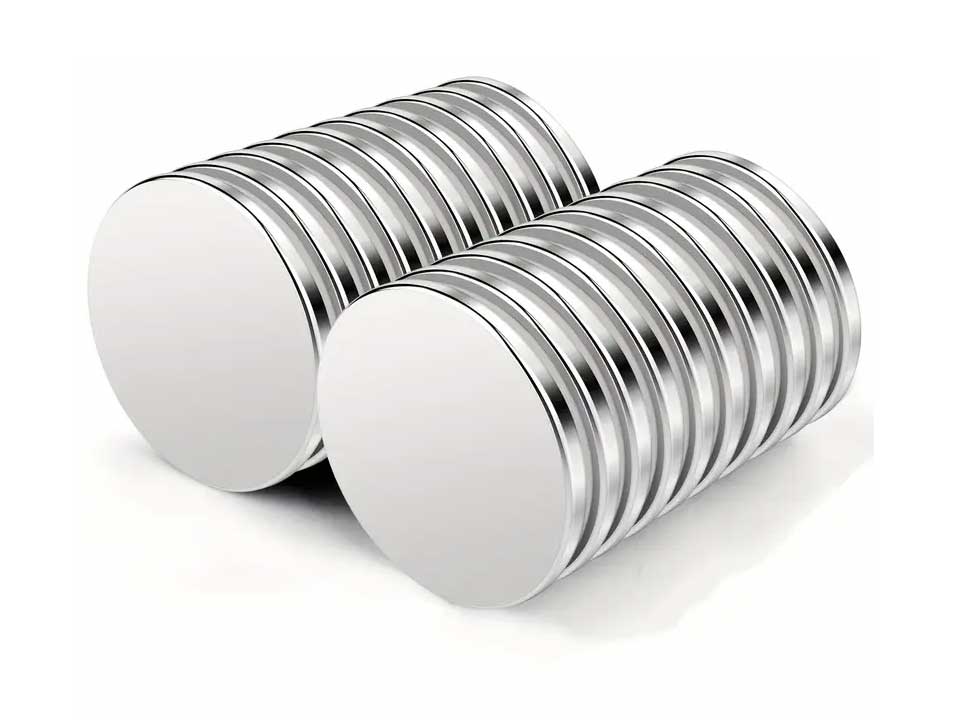
Neodymium is brittle and the edges are the weakest point. Chipping usually happens when magnets snap together from a distance or when they slide across a hard surface. Handle them gently, store them with spacers, and slide them apart rather than pulling directly.
Conclusion
Neodymium disk magnets are simple components that solve a wide range of problems, from holding a cabinet door closed to driving a speaker cone. Their performance comes down to diameter, thickness, grade, temperature rating, magnetization direction, and coating. Specify all of these together, verify with samples, and keep realistic expectations about real-world holding force. Done right, they become one of the most reliable and versatile tools in your design or workshop.
How to Choose Strong Ring Magnets for Holding, Sensing, and Assembly